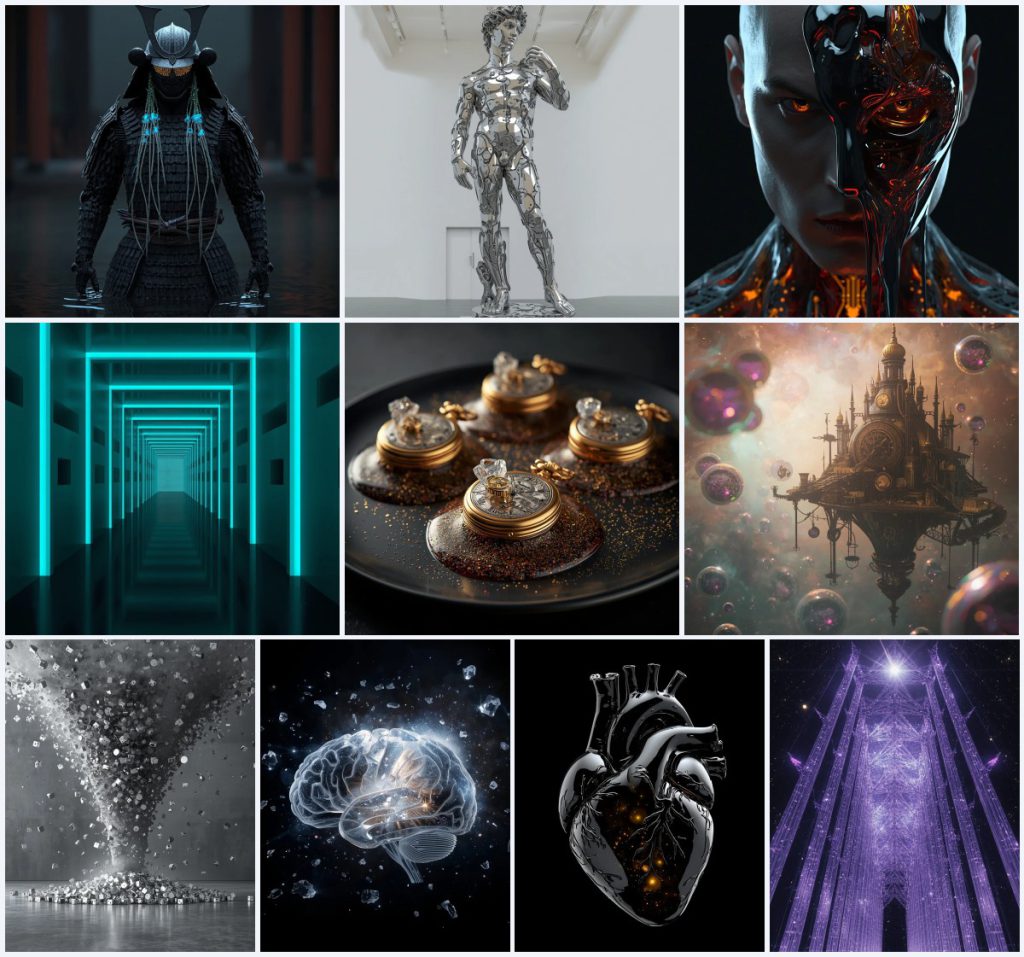


New 10 AI Prompts for Vibrant Graffiti Art Murals on Urban Walls
Graffiti art has always thrived on reinvention, and AI image prompts now let you push that reinvention into surreal territory. This collection gathers ten vivid concepts that share one stage: an urban wall transformed into a canvas for hyper-detailed, high-contrast murals. Whether you are painting with light beams, chrome gears, or living mercury, each prompt asks for the same wall-bound scale and public boldness.
The ten card titles range from Obsidian Samurai Armor Infused with Pulsing Bioluminescent Deep-Sea Jellyfish Arteries to Cathedral of Fractal Light Suspended in a Non-Euclidean Cosmic Void. Between them sit a chrome-gear David, a mercury-masked cyborg assassin, an infinite library of solidified light beams, melting pocket watches on stardust plates, a Victorian clockwork city inside soap bubbles, a tornado of silver dice, a shattered quartz brain nebula, and a ferrofluid human heart. Every one of these is imagined as a mural on an urban wall, so the article treats them as a single set with a shared scene.
What this graffiti mural prompt set is asking for
The set asks for ten separate mural concepts, each one rendered as if painted or installed on a large outdoor wall. The prompts are written as hyper-detailed conceptual art pieces, so the model must balance public-scale composition with microscopic texture. Instead of a single subject, you get a roster of impossible objects and figures, all unified by the idea of a wall that becomes a portal. The details below are the concrete anchors that appear across the collection.
- Matte-black obsidian armor plates held together by neon-teal jellyfish tentacles that pulse with bioluminescent light.
- Polished chrome gears, springs, and mechanical parts forming the entire body of a classical statue in a bright gallery.
- A mercury-like substance flowing over half a face, with gold-plated circuits and red fiber-optic threads beneath.
- Solid horizontal beams of neon-cyan light acting as bookshelves, with floating rectangular blocks of absolute shadow as books.
- Antique gold pocket watches melting into a glowing, syrupy puddle of multicolored stardust on a matte-black plate.
- A colossal gothic cathedral built from iridescent, self-replicating fractal light beams in a pitch-black cosmic void.
The shared urban wall scene
Every prompt in this collection is framed as a mural-scale image, so the wall itself becomes part of the composition. The obsidian samurai stands in a dark, flooded temple hall, and the water at his feet reflects the eerie, pulsating blue glow of his armor. The chrome-gear David is placed in a bright, minimalist art gallery, while the cyborg assassin reflects a dark, neon-lit environment in flowing metal. The infinite library stretches into a dark, reflective floor, and the melting pocket watches sit on a sleek, matte-black plate under sharp studio lighting.
The later prompts push the wall into cosmic and abstract territory. The Victorian clockwork city floats in deep silence, surrounded by millions of gigantic, glowing soap bubbles. The tornado of silver dice tears through a flat, grey landscape against a stark, matte, monochromatic concrete wall. The quartz brain explodes into a dense, swirling nebula of stars, cosmic gas, and supernovas. The ferrofluid heart hangs in a stark, light-absorbing black void, and the fractal cathedral curves inward and outward in ways that defy human perception. In each case, the urban wall is the stage, and the prompt supplies the impossible weather.
Why these mural concepts work on a wall
These prompts work because they combine public-scale drama with private, obsessive detail. A passerby sees a bold silhouette; a close observer sees micro-textures. That double reading is exactly what great street art does, and these ten cards are built for it.
- The contrast between matte surfaces and glowing elements, such as obsidian plates against neon-teal tentacles, reads clearly from a distance and rewards close inspection.
- The impossible objects, like a tornado of mirror-polished silver dice or a cathedral of fractal light, give the wall a sense of motion and wonder that static graffiti often lacks.
- The shared urban setting, from flooded temple halls to concrete walls, keeps the collection coherent while letting each card feel like its own event.
Three styles that stay inside this prompt set
You can steer the look without leaving the prompt's own language. The three styles below are all supported by the text and keep the mural feeling like one collection. Do not add a collage instruction; each card is already a single scene, and the styles should respect that.
- Hyper-detailed conceptual art: Lean into the phrase 'hyper-detailed conceptual art piece' by asking for sharp focus on every gear, droplet, and circuit node.
- Cinematic macro photography: Use the prompt's own 'macro photography' and 'cinematic lighting' cues to make the mercury mask or ferrofluid heart feel like a film still.
- High-end surreal culinary: For the melting pocket watches, stay with 'commercial luxury aesthetic' and 'surreal food styling' to keep the stardust syrup looking edible and expensive.
How to generate these graffiti murals step by step
The workflow is the same for all ten cards, whether you are rendering the obsidian samurai or the fractal cathedral. Work in one card at a time, and keep the wall-scale framing in mind. The steps below cover the full loop from prompt to final check.
- Copy the prompt. Paste the full card text into your image tool, including the resolution and style tags, so the model sees the same anchors you do.
- Upload a reference. If you have a photo of a real wall, upload it as a composition reference, but keep the mural content from the prompt.
- Generate the first pass. Run a batch of four images at a square or wide aspect ratio, since murals read best on a horizontal wall.
- Check hands and face. For the samurai, cyborg assassin, and David, zoom in on hands and face first, because chrome and mercury often distort anatomy.
- Check the main object. Confirm that the central object, such as the tornado of dice or the quartz brain, is the clear focal point and not lost in background noise.
- Refine and upscale. Use inpainting on the weakest area, then upscale once, because the prompts ask for 8k resolution and sharp focus.
Using a reference photo for the wall
A reference photo helps you match perspective and lighting, especially if you want the mural to look like it belongs on a specific wall. You do not need a perfect photo; you need one that shows the wall's angle and the light direction. The three points below keep the reference useful without letting it hijack the prompt.
- Shoot the wall straight on if possible, so the model can map the mural without fighting extreme perspective.
- Include the ground or surrounding architecture in the frame, because the prompts mention reflective floors and flooded halls that need a surface to sit on.
- Avoid heavy shadows or glare on the wall, since the prompts already specify dramatic lighting and you do not want to double the contrast.
Which AI tools handle these murals best
Different tools have different strengths for this set. The table below compares four popular options, with a note on how each one handles a real detail from the prompts. Use it as a starting point, then test the card you care about most.
| Tool | Access | Typical realism | Useful here for |
|---|---|---|---|
| ChatGPT | Web and mobile, free tier with limits | Medium to high, strong at following long text | Parsing the full samurai prompt with its obsidian plates and neon-teal jellyfish tentacles. |
| Google Gemini | Web and mobile, free tier with limits | Medium to high, good at scene coherence | Keeping the flooded temple hall and the water reflection consistent with the pulsing blue glow. |
| Leonardo AI | Web, free credits then paid | High, with strong texture control | Rendering the polished chrome gears and circular reflections on the David statue. |
| Midjourney | Discord and web, paid | Very high, cinematic and stylized | Capturing the mercury-like substance flowing over the cyborg assassin's face with red fiber-optic threads. |
Three tips for cleaner mural results
Small adjustments to the prompt language can save you a lot of rerolling. These tips name real materials and objects from the collection so you can apply them directly. Keep the wall-scale framing in mind as you test.
- When rendering the obsidian samurai, add 'matte-black, razor-sharp obsidian plates' near the start of your prompt so the armor texture does not turn glossy.
- For the melting pocket watches, specify 'antique gold pocket watches' and 'multicolored stardust' separately, because the model may otherwise blend the metal into the syrup.
- For the ferrofluid heart, mention 'sharp, organic, moving spikes' and 'golden liquid energy' to keep the surface wet and the internal glow visible.
Common issues and what to change
These prompts are ambitious, and failures are normal. The table below lists four issues this collection can actually produce, along with the change that usually fixes them. Address one issue at a time so you can see what worked.
| Issue | What to change |
|---|---|
| Chrome gears look like flat stickers instead of three-dimensional parts | Add 'brilliant, circular reflections' and 'micro-texture' to the prompt, and increase the lighting contrast. |
| The mercury mask drips off the face entirely | Reinforce 'half-obscured' and 'flowing and drips as if alive' so the metal stays attached to the subject. |
| The tornado of silver dice loses the individual dice | Ask for 'each individual die captured mid-air' and reduce the motion blur on the central vortex. |
| The fractal cathedral turns into a solid stone building | Repeat 'iridescent, self-replicating fractal light beams' and 'non-Euclidean space' to keep the architecture impossible. |
Frequently Asked Questions
Can I use these prompts for a real wall mural project?
Yes, the prompts are written as mural-scale concepts, so you can use the generated images as mockups for a real wall. Just remember that the final painted version will need its own color matching and surface preparation.
Which card in this collection is easiest for a beginner?
The chrome-gear David is the most forgiving because the subject is a single statue in a bright gallery. The tornado of silver dice and the fractal cathedral are harder because they demand many small, consistent details.
Do I need to upload a reference photo for every prompt?
No, a reference photo is optional. It helps most when you want the mural to match a specific wall's perspective, but each prompt already describes its own scene, so you can generate without one.
Conclusion
This collection turns ten impossible ideas into a single urban wall language. From the obsidian samurai to the fractal cathedral, each card gives you a bold silhouette and a deep well of texture. Start with the card that excites you most, copy its prompt, and let the wall do the rest. The set is coherent enough to hang together and varied enough to keep you generating for hours.
Only edit or publish a photo you have the right to edit, and credit the original wall or photographer when you share your mural mockups.